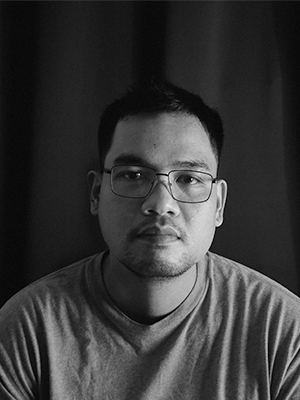
Vince Honrado Imbat is a Los Baños-based Pangasinense writer exploring the potential of walking as embodied worldmaking and contemplative practice. His essays and poems, recognized by the Gawad Bienvenido Lumbera and Gawad F. Sionil Jose, engage with the tensions of history, language, and the sacred embedded in landscapes and places. His work has appeared in Katipunan, Mountain Beacon, Northern Dispatch, and Rappler, and his poetry and photography have been exhibited in Laguna, Cavite, and Rizal. He is a fellow of the Ateneo National Writers Workshop, Palihang Rogelio Sicat, the Bienvenido Lumbera Seminar-Workshop on Translation, and the Writings-in-Progress Traveling Writing Workshop of Savage Mind and the Goethe-Institut Philippinen. A freelance writer and editor, he also teaches poetry at the Philippine High School for the Arts.
tan saray un-uni na anuyiao naabuëk a tawënPigaran dakot na asin lay insibuag ko'd bintanak. Mandongilngil ira’y musian managogul. Akin kinëmkëm so dërlëng mon bëngër? Anta manpapanabos ni lambëngat. Piaët a makabolos so ilalam. Singamuno inkolada'y kawës a apagëw. A kuan mo no manuk a binmayës na bagu to. Among all the natives of these islands, the Pangasinanes appear to me to be the most active and industrious, very energetic in producing profit and knowing how to make a scantly capital increase in all possible manner. Nagmaliw a pugaro'y Parnasu. Amagamaga'y dalin, tan baog — nanparan limmëtak. Anggan say ësaës, nakatan la. Katon natan ët singa ta bulong a apiglas. Ontëtëdtër so dinmanum a liknaan. A nën kalabian da ni'n ampopo. Dalayonë'y tarëm so sankagatin a pitëk. Ta pian manlukon a amayamay a tëpët. Naipaway lay kawës a atalimagmagan. Kasanlilikna labusa'y mansasabon posapos na ilalam. Lobir ya amalur, angga'd natan ag ni apaksot na dila ton nanaandi bubuninëngë'y kisame. Ag makarëën so kamarërwak, mangakalitong na dungap. Lakapën to ka anggano ag mampapatanir. Tinmaynan ak ta pian naanap ko’y dilak ya abayag kon alingwanan a gawak. Tuan aliwan magano so mangitilak. Ëd insaëw da'ray labitëwën aliwa lan malinak so labin pitutuyawan ko ëd ilalam. Gala ëd silir kon ambilungët. Sika so anlong kon ag nasumpal.
Renaissance
translation
and songs of sparrows of a drunken sky
*
"Renacimiento" and its English translation draws from the following references: "Balikas na Salita," "Dakat," and "Anlong" by Alma Ariola-Nepascua; Provincia de Pangasinan, 1819 by Ildefonso de Aragon; "Sonito 178," "Sonito 188," "Sonito 129," and "Sonito 283" by Santiago Villafania; "Bisita," "Sikaton Agla Ompawil," "Abalang," and "Lingwanan" by Gloria Alesna; "Tongtong nën Lea," "Mamidwan Ibutay na Agëw," "Ëras na Laman; Ëras na Kanunotan," and "Pluman Makabilay" by Lexon Castillo; "Pangimaton," "Inaro Da'y Musia," and "Nambabangil a Bonikëw" by Melchor Orpilla. The photograph is originally from the Keystone View Company and is now in the public domain.
Agmi la inekas may mais ya impaagew mid kalsada
ta kien
tayaketek la tan nitan lay mabalasubos ya uran
ta kien
wala kuno amoy super typhoon
tan kien
diya ondulan so mata to naani nu labi.

Anggapo met so anggan kariton min panginan
ta kien
aderal la may kuliglig ya babayesen mid si Marlon
tan kien
anggapoy ibayar mid nu siopa tay walay luganan to
ta kien
gawat.

Mankulibenben ka la siriy tuwalya
ta kien
ibaan mo ak ya ompawil dimad kalsada
ta kien
kalkalnaan tan kopkopen nu antoy nakopkop ta
ta kien
isako tan amin.
Tagsalat
salin
‘Di na namin kinuha ang mais na ibinilad nami sa kalsada
dahil kuwan
umaambon na at nariyan na ang malakas na ulan
dahil kuwan
meron daw atang super typhoon
at kuwan
dito dadaan ang mata niya mamayang gabi.

Wala man lang naman kasi kaming maski kariton na paglalagyan
dahil kuwan
sira na ‘yong kuliglig na hinihiram namin kay Marlon
at kuwan
wala kaming pambayad sa sino mang may sasakyan
dahil kuwan
tagsalat.

Ipambalabal mo na ‘tong tuwalya
dahil kuwan
samahan mo ‘kong bumalik sa kalsada
dahil kuwan
unti-untiin nating tipunin kung ano ang matitipon natin
dahil kuwan
isako natin lahat.