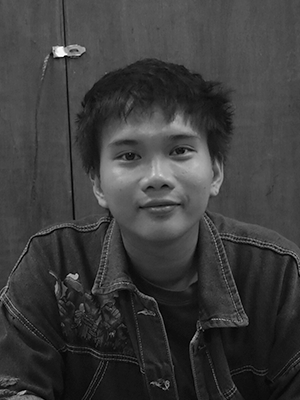
Joseph Eli Occeño holds a Bachelor of Culture and Arts Education from the Philippine Normal University - Manila where he served as editor-in-chief of The Torch Publications. His works have appeared in ENTRADA Volume XI, Folklore Review, Haluhalo Journal, Manila Today, The Metro Manila Review, and Pinoy Weekly. He was a fellow in the 9th Amelia Lapeña-Bonifacio Writers Workshop of the UP Institute of Creative Writing, the recipient of the Gawad Graciano Lopez Jaena for journalism and two Gawad Severino Montano awards for playwriting.
Translate to Hiligaynon:

1.         I’m not exceptional. I keep saying that because it sounds defensive, which is fitting, I
            guess. If I were exceptional, I wouldn’t have to announce it. I’d just be unbearable
            in quieter ways.

2.         We ate. Regularly. We were educated just enough to learn when to shut up about wanting
            more. So when hunger showed up after Typhoon Yolanda, it learned to behave itself. It
            learned manners. Didn’t make a scene. Now that kind of hunger doesn’t get monuments.

3.         People expect me to start with the sea. Everyone does. As if geography explains
            character. The sea is here. It shows up every day like a government employee who knows
            he can’t be fired. People call that industry. It’s not. It’s repetition.

4.         Roxas taught me how to wait without demanding reasons. How to say at least like it was
            a philosophy. At least there’s fish. At least there’s rice. At least there’s work,
            occasionally. At least the mall exists so we can walk in cold air and pretend we’re headed
            somewhere. At least the port still works. At least nothing is actively on fire.

5.         My childhood wasn’t miserable. This is inconvenient because we had enough to delay
            anger indefinitely. Enough to make gratitude automatic. Enough that complaints felt
            theoretical, like exercises in a textbook no one expected us to answer honestly.

6.         I loved the place the way you love a relative who never quite figured things out. You
            defend them on reflex. Then you start lowering your voice. You say things like “could
            have been great.” You don’t say what happened to it.

7.         They told us we were becoming a city. I believed them, which says more about me
            than I’d like. There were signs: glass, concrete, slogans, festivals named after progress.
            Malls—small ones. Careful ones. Malls that didn’t want to scare the surrounding poverty.
            Skyscrapers that stood up halfway and thought better of it. Windows that reflected
            workers arriving tired and leaving tired, just at different hours.

8.         Inside those buildings, everyone stood a little straighter. Outside, tricycles kept fighting
            potholes and losing. Wages arrived late. And sometimes they didn’t arrive at all. I
            remember thinking that if I stayed under those fluorescent lights long enough, something
            in me might improve. Like refrigeration. Even though refrigeration improves nothing,
            yes, I know. It defers rot. I never said it was a smart thought. It’s just the kind you have
            when options are limited.

9.         We walked in the mall because it was cool. Because it was modern. Because walking
            anywhere else looked suspicious. Roxas isn’t detached. That’s too kind. It’s distracted
            from itself. Always looking sideways. Iloilo with its confidence. Pristine Antique and
            Binirayan. Boracay with its loud, ugly success. People say aspiration instead of envy
            because it sounds cleaner. Aspiration implies choice. This didn’t feel chosen. It felt
            assigned.

10.       See, nothing essential changed. Fishermen aged. Farmers bent their backs. The young
            learned how to leave politely. The rest perfected staying without complaint.

11.       And I left too. Let’s not pretend it was brave. Staying was starting to feel like a skill I was
            getting good at, and that terrified me. Endurance was circling, looking for somewhere
            permanent to land so I panicked.

12.       Of course I carried Roxas with me. It’s like bad posture. You don’t notice it until
            someone else does. I heard it when I spoke. Saw it when people smiled too fast. “Oh,
            that’s nice,” which means small. They always means small. I learned how to compensate.
            I curated my hometown. The sea. The food. Safe details only. Never the mornings when
            the port was quiet because nothing came in. Never fishermen apologizing for bad seasons
            like they’d mismanaged the weather. Never the waiting. God, never the waiting.

13.        I don’t trust my voice when I talk about home. It’s been trained. Polished. I can hear
            myself translating while I speak, explaining poverty like climate—unfortunate,
            unavoidable, nobody’s fault. Somewhere along the way I learned that plain anger sounds
            unsophisticated, and sounding unsophisticated is apparently worse than being wrong.
            This feels important. I don’t like that it does.