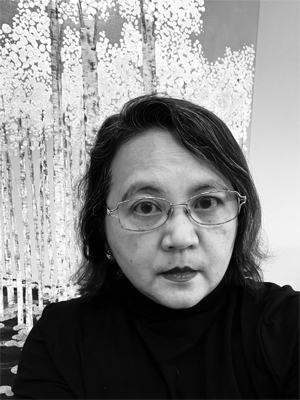
Eileen R. Tabios has released over 60 collections of poetry, fiction, essays, and experimental biographies from publishers in 10 countries and cyberspace. Forthcoming in 2023 is the poetry collection Because I Love You, I Become War. Recent books include a first novel DoveLion: A Fairy Tale for Our Times; two French books, PRISES (Double Take) (trans. Fanny Garin) and La Vie erotique de l’art (trans. Samuel Rochery); and a book-length essay Kapwa’s Novels. Her award-winning body of work includes invention of the hay(na)ku, a 21st century diasporic poetic form; the MDR Poetry Generator that can create poems totaling theoretical infinity; the “Flooid” poetry form that’s rooted in a good deed; and a first poetry book, Beyond Life Sentences, which received the Philippines’ National Book Award for Poetry. Translated into 12 languages, she also has edited, co-edited or conceptualized 15 anthologies of poetry, fiction and essays. Her writing and editing works have received recognition through awards, grants and residencies. More information is at http://eileenrtabios.com.
             “Adding Philippine English words to the OED is about something
             we hear a lot these days—representation. We, in the OED, believe that the
             Philippines, just like this country, is part of the English-speaking world.
             And as such, Philippine culture, Philippine history, the Philippine experience
             must be represented in this great work of scholarship on the English language.”
             —from “Bongga! What having Philippine English words in the Oxford English
                Dictionary means,” Philippine Star, June 28, 2019
            CONSTRAINT: Write a poem featuring
            the following additions to the OED: Pan de sal,
            Gimmick, Kilig, OFW, Kikay kit, Bongga,
            Halo Halo, Pancit, Comfort room, and Trapo

1.
It’s historical, daw
to insert
Filipino

words into this
very proper
Oxford

English Dictionary, this
Book that
more

than defines words
but also
provides

the history that
shaped the
Language—

a language that
colonized us
so

deeply we’ve even
become English
Poets.

Entonces (to quote
another colonizer),
we

make history by
revising history
through

adding to—changing—
the very
language

that subjugated our
words through
erasure.

We give you
“pan de
sal”

without its salt.
We give
you

“halo-halo” without bothering
to explain
how

the Japanese, more
colonizers, introduced
“mongo-ya.”

We give you
“pancit” to
enhance

your turn to
fast food
instead

of more nutritious
thoughts. We
give

you “kikay kit”
with whitening
products

inside its plastic.
We give
you

“kilig” because we
find you
romantic

despite all that
we have
suffered.

We give you
“comfort room”
although,

wait for it,
there’s no
comfort

found in language
which is
fickle

and refuses morality
and other
worthwhile

traits with syllables
like “am,”
“anti,”

“dis,” or “un.”
We give
you…

But we cannot / keep giving / affirmations.

We must also
give you
authenticity.

So we give
you “OFW”
for

the generations created
from centuries
of

“anguish,” “betrayals,” “corruptions,”
“abuses,” “thefts,”
“venalities,”

and so many
more English
words

to lead us
finally to
yet

another gift for
your English
Dictionary:

“trapo,” short for
“traditional politician”
who

is “traditional” for
belonging to
that

ruling class who
you English-speakers
enabled

to ignore then
forget the
ultimate

code for guiding
the responsible
development

of any nation:
“With great
privilege

comes great responsibility.”
Who cares
about

an extra word
here and
there

when “trapos” insist
on lives
beyond

mere words. In
this country
with

17 billionaires, the
poor eat
“pagpag”—

the one word
that your
English

Dictionary should have
included long
ago.

This whole matter
lapses to
gimmickry.

Our people don’t
eat enough
pan

de sal, halo-halo, or
pancit. We can’t
afford

experiences that would
make us
go

kilig with excitement,
joy, or
hope.

The notion of
a “comfort
room”

is laughable when
we all
piss

and shit into
the same
rivers

where we bathe
and drink.
Our

children grow up
without knowing
who

bore them into
their paltry
existences.

Not a single
trapo will
read

this poem whose
existence inappropriately
aspires

to its English
Title—definition:
“impressive”

2.
“Pagpag” is defined
as the
practice

of scavenging through
trash heaps
for

food. Due to
its prevalence
we

most assuredly will
give you
“pagpag”—

how then, my
people, will
we

take pride in
such an
achievement?